Whether you have ever seen the ballet or not, The Nutcracker remains a popular icon for the holiday season. Between the tune of the Waltz of the Flowers, the millions of nutcracker holiday decorations to buy, and the many references in pop culture, The Nutcracker is sure to evoke feelings of seasonal nostalgia all over the world. The two-act classical ballet is adapted from E.T.A. Hoffman’s 1818 story The Nutcracker and the Mouse King, choreographed by Marius Petipa and Lev Ivanov, with music written by Russian composer Peter Tchaikovsky in 1892.
The story of the nutcracker told on stage follows a young girl- usually named Clara- and her journey with a nutcracker doll-turned prince. The ballet opens with the gathering of family and friends on Christmas Eve. Clara’s godfather, Drosselmeyer, brings gifts for each child, their excitement bringing the spirit of Christmas to the stage. Clara receives a
wooden nutcracker doll, which her brother Fritz accidentally breaks. Drosselmeyer quickly fixes the doll, and Clara awakes in the middle of the night to check on it. To her surprise, the family’s Christmas tree begins to grow, as does the nutcracker, as mice scurry across the stage. Along with the mice, a sometimes-multi-headed mouse king appears on stage. The nutcracker leads an army of soldiers into a battle against the mice and their king, a comedic scene that triumphantly ends in the mice’s defeat. The nutcracker then transforms into a prince, leading Clara on a snowy moonlit walk before the curtain typically falls for an intermission. The second act of the ballet takes place in The Land of the Sweets, a magical kingdom ruled by the Sugar Plum Fairy- an intense soloist role. Clara and the nutcracker are presented with a multitude of performances and celebrations. The two are greeted by dances
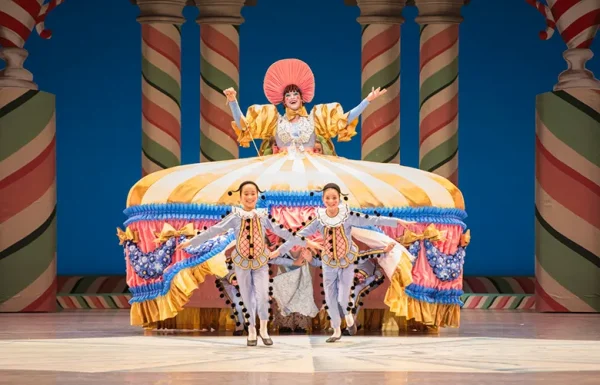
from Chocolate from Spain, coffee from Arabia, tea from China, candy canes from Russia, Marzipan shepherdesses and their flutes, Mother Ginger- a hilarious role typically played by a tall man wearing a ginormous skirt, the Polichinelles that appear out from under her skirt, and finally the Sugar Plum Fairy and her Cavalier, who then send off The Nutcracker and Clara with one final goodbye.
The props, costumes, scenes, and beauty of the two acts come together to tell a
magical holiday story. Both the lightness and strength of the style of ballet continue to leave audiences speechless each year. It is truly fascinating how clearly the story is conveyed solely through music and movement. The Nutcracker is a story known and loved across the world.
But just how did the ballet gain its popularity, and how does it remain such a prominent holiday tradition over 100 years later?
The Nutcracker’s premiere in Saint Petersburg was primarily deemed a failure due to audience criticism and confusion. Nevertheless, the tale continued to spread across the world through music and dance. Companies in Europe and America adjusted the original 1892 ballet for their performances throughout the early 1900s. The San Francisco Ballet performed the United States’ first complete version of The Nutcracker on Christmas Eve of 1944, magically capturing the essence of the evening on the stage- a German home’s Christmas Eve party. The San Francisco Ballet still performs the ballet each holiday season, bringing the same magic and creating a tradition for many companies to follow suit. 10 years following San Francisco, George Balanchine’s New York Ballet premiered their first version of the ballet; Balanchine’s version, still widely used today, further popularized The Nutcracker in America. The NYC Ballet, too, performs the piece annually.
After it became a holiday tradition, the ballet and its performances continued to evolve. Choreographers have since transformed the familiar story into modern pieces, allowing light to shed on important issues and audience members to think about the world around them. In 1991, Mark Morris created his adaptation, titled The Hard Nut. Morris’ rendition occurs in 1960s suburbia, questioning and challenging the era’s trends of conformity and gender roles. Morris had many traditionally female characters played by men, and vice versa. Additionally, contemporary critics of The Nutcracker have condemned racist stereotypes seen t
hroughout the portrayal of different countries in the Land of the Sweets. To continue tradition and adapt the ballet appropriately, many choreographers have noted and highlighted these major issues. Asian American ballet dancer Phil Chan co-created the non-profit Final Bow for Yellowface through the Nutcracker, addressing the issue of racist depictions of Asian people on stage. The non-profit has worked with famously noted companies such as the San Francisco Ballet and the New York City Ballet to adapt works of the ballet and rid of harmful interpretations.
Since the original 1892 Saint Petersburg’s performance, The Nutcracker has become a classic holiday tradition and tale. It has continued to evolve into different versions and stories, allowing storytellers to convey and present broader topics. Year after year, it is many ballet companies’ most popular performance, despite its timely exclusivity.
Whether it is a local or professional performance, I highly recommend attending a Nutcracker show this holiday season!